

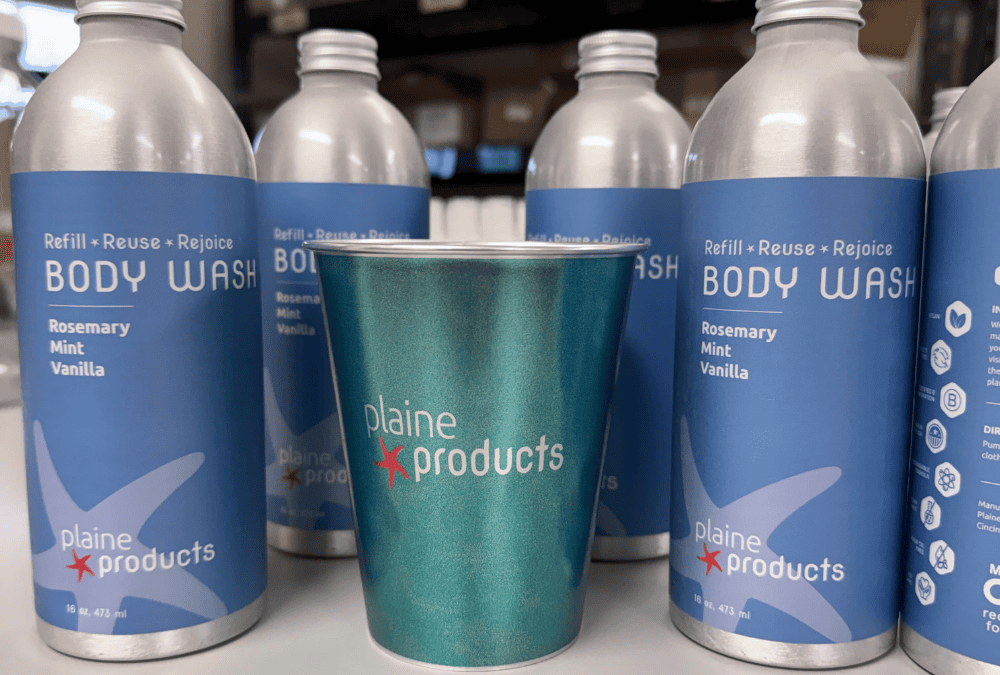
This is a guest post from our friends at LumiCup.
In 2019, my husband and I glimpsed a path to a more sustainable future by looking backward – to 1959. That’s the year the Adolph Coors Company unveiled the first aluminum beverage can, triggering the mass, global adoption of that now-universal technology. We had been searching for a legitimate alternative for the almost 500 billion-plus single-use plastic (SUP) cups sold annually and, pretty much in unison, slapped palms to foreheads the day we realized a single-use aluminum cold cup could be the key to moving consumers off their plastic addiction.
What is plastic’s polar opposite? A material that’s so infinitely recyclable that every Plaine bottle and every LumiCup sold today retains a few dozen molecules of that very first Coors can.
At their core, both companies address the same enormous challenge: encouraging consumers to change lifelong habits. We’ve all developed patterns that make our choices a reflexive act – largely unnoticed because we’ve repeated them so many times. Where Plaine makes it easy for customers to simply purchase the consumable part of their hair care regimen, Lumi offers a drinkware switch that swaps out the least-recyclable material on the market with the most-recycled material available. In both cases, the key to success is getting people to try them out and discover their superior performance.
Disposables are way overdue for a rethink.
Decades of misleading industry messaging led consumers to believe their plastic discards were magically transforming into other useful products. The deception worked for a long time, but today’s consumers are increasingly aware that single-use plastic is a serious problem. And yet, they remain in need of easily adoptable options that duplicate the experience they rely on for many tasks. For cold cups, Lumi created a drinkware experience that far exceeds what people have long accepted from single-use plastic, yet performs to the same size, weight, and stacking specifications that business customers require.
Aluminum, as it turns out, can take on most of the shapes that plastic can. Beyond that, it does an exceptional job of keeping cold drinks cold for about 70% longer than a single-use plastic cup does. For anyone trying to enjoy a cold drink on a hot day, that’s a meaningful difference for keeping your ice from melting.

And unlike single-use plastic cups, the end of the drink isn’t the end of the story for a LumiCup. Thanks to 66 years of training on aluminum cans, people intuitively understand what to do with their empty aluminum cup. It goes in the same recycling bin they’ve used for years and gets processed in the exact same way. In fact, because aluminum carries such a high value, even improperly sorted cans and cups are often recovered during sorting – it’s worth it to the waste handler to fish them out.
Within about 60 days on average, waste aluminum returns to store and stockroom shelves in the form of a new product. Aluminum doesn’t degrade or diminish as it ages – it’s every bit as strong and pliable the 100th time it’s used as it is the first time. So, consumers choosing aluminum products are participating in one of the most virtuous product cycles available. Your container has probably already been recycled more times than you’ve had birthdays, and it will continue to service our economy merely by being properly sorted at the bin.
LumiCups are made from 90% post-consumer recycled content, which also means their carbon footprint is very low – lower than the SUP cups they replace. More great news is that the world is really good at recycling aluminum. In most of Europe and Asia, more than 70% of aluminum is recycled every year – though that number is much higher in some particularly capable countries. America does a decent job with a recycling rate that floats in the 60% range, but if it were to raise its game to match the overseas standard, we’d gain a lot more affordable and eco-friendly metal for commercial and industrial uses.

Our cultural concept of how we should make things is finally starting to unstick from the self-defeating methods that were once an easy default choice. The avalanche of single-use plastic is simply untenable for our planet and its future residents. Many of us grew up in a world where waste plastic didn’t shadow our every step in every natural space we visited. Regrettably, today’s and future generations will never know that world. We can begin to reverse that tide by finding ways in our daily routines to swap in refillable products or single-use items with unlimited recyclability and the greatest odds of reuse.
Lumi is fundamentally optimistic about the future course of these important choices; otherwise, we would not have invested so much into building this brand. Society is moving in our direction as well, as companies large and small feel pressure to source more sustainably and reflect the value standards of their customers. Where offering sustainable products was once seen as an exceptional move, now it’s increasingly seen as a basic responsibility. The best part of this virtuous cycle is that as more people gain exposure to these great options, the transition becomes self-reinforcing.
Where we once accepted that a “sustainable” product came with certain limitations or required us to sacrifice some degree of convenience, the opposite is now the case. Today’s generation of sustainable products are proving we can exceed consumer expectations while safeguarding our shared environment. A quirk of history may be that single-use plastic had such an uninterrupted run – certainly longer than you see in just about any other category. People are used to rapid changes in smartphones, fashion, food, and anything cultural, but they got a bit stuck on the idea that plastic is the only way to make a useful container.
Single-use plastic, like skinny jeans and cronuts, has seen its time come and go. We may have liked it back in the day, but we’ve moved on, and we don’t need to look back. Lumi is pleased to stand with Plaine Products in offering “what’s next,” and making sure – this time – it’s going to be a good choice.
Paul Kradin is the Chief Sustainability Officer at Lumi, manufacturer of recyclable aluminum drinkware like the LumiCup -- the lightest single-use aluminum cold cup on the market.


 Need a return label?